Chaos Drink Sort: Water Puzzle
- 4.7
- Rating
- 1.00M
- Installs
- Free
- Price
 Analysis by App-foxy
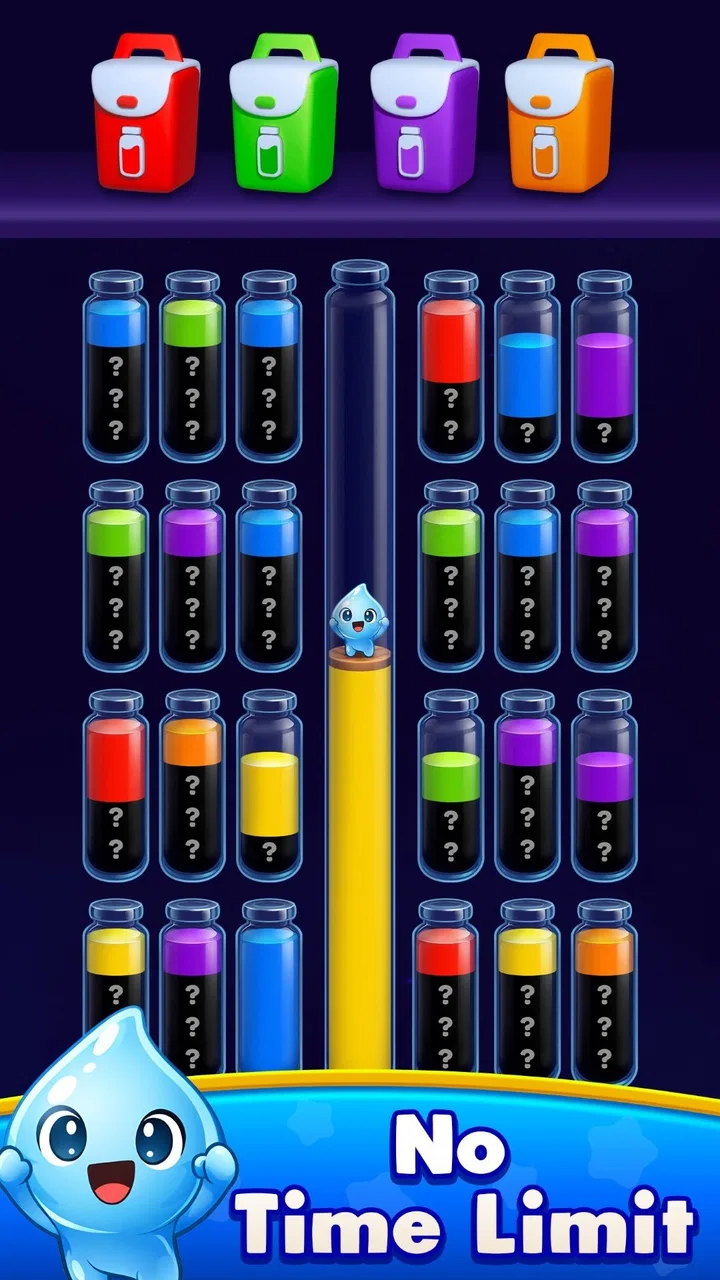
I went into Chaos Drink Sort: Water Puzzle expecting a familiar color-sorting game, and that is mostly what I found—but with a messier, more playful presentation than the usual tube-and-liquid puzzles. The basic task is easy to understand: arrange the colored drinks so that matching colors end up together. The appeal comes from planning several moves ahead while trying not to trap yourself with a badly chosen pour.
My overall impression is positive. This is a good fit when I want a quiet puzzle that I can play in short bursts, without learning a complicated rule set. It is less convincing for anyone looking for a deep strategy game, a story-driven experience, or a completely distraction-free session. The central sorting idea is familiar, but the “chaos” framing gives it enough personality to stand apart from the most plain alternatives.
What makes the sorting feel satisfying
The strongest part of the game is the way it turns a simple visual problem into a sequence of small decisions. At first, a level can look almost solved because two matching colors are visible near the top of separate containers. Then one blocked color forces me to use an apparently useful space elsewhere, and the whole arrangement changes. That is where the game earns its place as a puzzle rather than just a color-matching exercise.
You May Also Like

 Blood Strike: 2.5 Anniversary
Blood Strike’s Loadouts Turn Every Drop Into a Tactical Gamble
A close look at Blood Strike’s custom loadouts: how fast access to signature weapons reshapes its battle royale rhythm, rewards preparation, and narrows the gap between fights.

 Pandora - Music & Podcasts
Pandora’s Music Is Easy to Start, but Harder to Recover
Pandora’s strength is its low-effort path from a seed to a station. Its weak spot is how much confidence it asks you to place in connection, setup, and quiet recovery.

 8 Ball Pool
 Is Built on Rivalries, Rematches, and Routine
A close look at the rivalries, rematches, shared routines, and unanswered safety questions that turn a quick pool match into a persistent mobile community.

 Samsung Music
’s Quiet Strength Is Playing What You Already Own
Its reach comes less from spectacle than from dependable access to a personal library. That simplicity is both the app’s strongest retention engine and its ceiling.

 AccuWeather: Weather Radar
AccuWeather Review: A Quick, Clear Forecast for Everyday Decisions
For everyday plans, the best forecast is the one you can understand quickly. AccuWeather makes rain timing, radar, and local conditions easy to act on, with a few trade-offs.

 Hill Climb Racing
Why Hill Climb Racing Still Turns Crashes Into One More Run
A tiny car, a bumpy hill and one more upgrade: Hill Climb Racing keeps resurfacing because its simple chaos makes every near-miss feel personal.
More From Our News Desk



I found the best rhythm by resisting the urge to pour immediately. Before making a move, I scan the available colors, identify which container can become a temporary workspace, and check whether the next pour will expose something useful. This habit matters more than speed. A quick move may look productive while quietly removing the only open space needed later.
The visual nature of the challenge makes it approachable. I do not need to remember a long set of rules or follow a complicated interface. The board communicates the problem directly, so the game works well when I have only a few minutes on a break. It is also the sort of puzzle I can pause mentally and return to without having to reconstruct a story or a large strategy plan.
That accessibility is one reason the game suits a broad audience. It carries an Everyone age rating, and the concept is simple enough for casual players who do not normally spend time with puzzle games. At the same time, later arrangements can still punish careless planning. The difficulty is not based on complicated controls; it comes from recognizing when a container is genuinely useful and when it is merely delaying a problem.
One practical tip helped me more than any attempt to play quickly: I treat empty space as a resource, not as a bonus to spend immediately. If I use every open container too early, I can end up with colors separated in ways that require unnecessary backtracking. Keeping one flexible space available often gives me a safer route through a crowded arrangement.
Another useful approach is to prioritize colors that are already close to completion, but only when finishing them will not seal away a color needed underneath. This is a small distinction, yet it changes the way I read the board. A nearly complete stack is not always the best next target. Sometimes the smarter move is to uncover a buried color first, even if that makes the board look less tidy for a moment.
That temporary disorder is where the title’s idea of chaos feels relevant. The game is not simply asking me to match what is visible. It encourages me to accept a few untidy moves in order to reach a cleaner final arrangement. I enjoyed that tension because it rewards patience without making the experience feel like a formal logic exam.
Useful for short sessions, but not a deep puzzler
In everyday use, I can imagine opening this while waiting for an appointment, taking a short break from work, or winding down before bed. A level does not demand the same attention as a long-form strategy game, and the visual objective is immediately clear. If I make a poor decision, I can usually understand why the position became difficult, which makes the mistake feel instructive rather than random.
The trade-off is that the core formula is narrow. Players who have already spent a lot of time with water-sort or ball-sort games may recognize the structure quickly. The presentation can make the experience feel fresher, but it does not transform the category into something entirely new. For me, that is acceptable because I value the low entry barrier, though it limits how long the game can remain exciting for experienced puzzle fans.
The game is free to start, which makes it easy to try without committing money upfront. It also includes in-app purchases ranging from $1.99 to $47.99 per item. That range is worth keeping in mind before handing the device to a child or allowing casual purchases. I would approach the game as a free casual option first and decide later whether any optional spending genuinely improves my experience.
I also would not choose it when I want a puzzle with a strong sense of progression outside the board itself. Traditional alternatives with narrative chapters, elaborate mechanics, or competitive rankings may offer more variety and a stronger reason to keep returning. This game’s strength is immediate, self-contained problem solving, not a large world or a complex long-term system.
Where the “twist” helps—and where it does not
The drink theme gives the familiar sorting structure a more distinctive identity than plain colored liquids in generic containers. It makes the board easier to recognize at a glance and gives the game a lighter mood. I found that useful because the visual theme helps separate it from other puzzle icons and makes the activity feel a little less sterile.
Still, the theme does not remove the main limitation of this type of game: repetition. Once I understand the best way to preserve empty space and avoid blocking a color, many boards begin to resemble variations on the same mental exercise. The game remains pleasant, but it is not something I would recommend as my only puzzle app if I need constant novelty.
There is also a difference between a puzzle being difficult and a puzzle being inconvenient. When a position becomes complicated because I misread the available space, that challenge feels fair. If the experience starts asking me to repeat familiar sorting patterns without adding a meaningful change, the appeal drops. My enjoyment depends on the arrangement feeling like a fresh decision problem rather than a longer version of an earlier board.
That is why I recommend playing thoughtfully instead of rushing through levels. The game is at its best when I study the arrangement, make a plan, and accept that the clean solution may require an initially awkward move. Players who tap rapidly and rely on undo-style recovery, where available, may find the process less satisfying because they miss the main strategic pleasure.
For a more relaxed session, I use the game as a mental reset rather than a test of speed. I focus on one container at a time, but I keep checking how that local move affects the rest of the board. This prevents the common mistake of completing one color while accidentally making every remaining color harder to access. It also gives the puzzle a calmer pace, which suits the game’s casual character.
Who should download it
I would recommend this game to someone who enjoys sorting, matching, and light logic puzzles but does not want a complicated tutorial. It is especially suitable for players who like visible progress: every correctly grouped color makes the board look more organized, and that visual change provides immediate feedback. The simple format also makes it approachable for family members who may not be comfortable with action games or complex controls.
It works well for people who prefer short, repeatable sessions. I can play a little, put it down, and return later without losing the basic idea of what I am doing. That makes it more convenient than puzzle games that require a long uninterrupted session or demand that I remember a detailed narrative objective.
I would be more cautious about recommending it to expert puzzle players who want unusual mechanics. If your favorite games involve deduction systems, rotating environments, wordplay, or carefully constructed story puzzles, the color-sorting foundation may feel too familiar. In that case, a more inventive puzzle title would probably offer better value for your attention.
It is also not my first choice for anyone who dislikes optional purchase prompts or wants a completely premium experience. The game is free, but the presence of purchasable items means the overall experience may feel different from a one-time paid puzzle with no spending layer. I would suggest checking your device’s purchase controls, particularly if younger players will use it.
The technical entry point is broad: the current version is 3.7.1 and it supports Android 7.0 or later. That makes it practical for people using older Android devices, provided the device meets that system requirement. The developer is IEC Holding L.L.C-FZ, and the game has reached over a million installs, which suggests that this style of play has found a substantial casual audience.
Its average rating is 4.7 from around sixteen thousand ratings, with eighty-seven written reviews shown alongside that score. I treat that response as encouraging rather than conclusive. A strong rating tells me many players enjoy the basic loop, but it does not change the fact that sorting games can feel repetitive if I play them continuously for long periods.
How it compares with familiar alternatives
Compared with a very plain water-sort game, this title has a more noticeable theme and a livelier identity. The underlying appeal remains the same—organize colors with limited space—but the drink presentation makes the activity feel less like a bare logic diagram. If I am choosing between two games with nearly identical rules, that extra personality would influence my choice.
Compared with match-three games, the experience is slower and more deliberate. Match-three titles usually reward quick pattern recognition and frequent visual effects, while this game asks me to protect future options. I prefer this one when I want to think quietly rather than react quickly. Someone who needs constant action may find the pauses between decisions too subdued.
Compared with narrative puzzle adventures, it offers much less context but far less commitment. There are no story details for me to track in the middle of a short session, which is convenient when I only want a small mental challenge. The cost of that simplicity is emotional range: the satisfaction comes from solving the board, not from discovering characters, locations, or plot twists.
Compared with premium puzzle apps, the free entry is an advantage for testing the concept. I can quickly discover whether this particular sorting loop suits me. A premium alternative may still be better for someone who values a polished, uninterrupted structure and is willing to pay upfront instead of navigating optional purchases.
The most important comparison, then, is not whether this game reinvents the puzzle category. It does not. The question is whether its presentation, accessible rules, and short-session format match what I want. For casual sorting, the answer is yes. For broad variety or advanced puzzle design, I would look elsewhere.
My final recommendation
After spending time with it, I see Chaos Drink Sort: Water Puzzle as a well-targeted casual puzzle rather than an ambitious all-purpose game. Its best quality is the balance between instant understanding and enough planning to make each arrangement feel meaningful. I like that I can start without preparation, yet still improve my results by learning to preserve space and think beyond the next pour.
The limitations are equally clear. The familiar foundation may not hold the attention of dedicated puzzle veterans forever, and the free-to-play structure includes optional purchases that some players will prefer to avoid. The drink theme adds character, but it cannot by itself solve the repetition that naturally comes with sorting games.
My advice is straightforward: try it if you want a free, approachable color puzzle for short breaks and enjoy making careful decisions with limited room to maneuver. Give it a pass if you need a story, a wide range of mechanics, or a premium experience with no purchase layer. For the right player, the real strength is its calm, visual problem solving rather than novelty. That is enough to make it a worthwhile casual download, as long as I treat it as a focused sorting game and not something it was never designed to be.
FAQs for Chaos Drink Sort: Water Puzzle
01What is Chaos Drink Sort: Water Puzzle about?
Chaos Drink Sort: Water Puzzle is a challenging and addictive puzzle game where players must sort colored liquids into separate glasses. Each level presents a more difficult arrangement of colors, requiring strategic thinking and planning to solve. The game aims to test your logic skills while providing a fun and engaging experience.
02Is Chaos Drink Sort: Water Puzzle free to play?
Yes, Chaos Drink Sort: Water Puzzle is free to download and play on both Android and iOS devices. However, it may contain in-app purchases and ads that can enhance the gaming experience or speed up progress. Users can choose to disable in-app purchases in their device settings if desired.
03What are the main features of Chaos Drink Sort: Water Puzzle?
The game offers a variety of features to keep players engaged, including numerous challenging levels, vibrant graphics, and intuitive controls. Players can enjoy the satisfaction of solving puzzles while competing with friends on leaderboards. The game also offers hints and the ability to undo moves for a more relaxed experience.
04Does Chaos Drink Sort: Water Puzzle require an internet connection?
No, Chaos Drink Sort: Water Puzzle can be played offline, making it an excellent option for those looking to enjoy the game without an internet connection. However, certain features like leaderboards, updates, and some in-app purchases may require online access.
05Is Chaos Drink Sort: Water Puzzle suitable for all ages?
Chaos Drink Sort: Water Puzzle is designed to be enjoyed by players of all ages. Its simple mechanics and progressively challenging levels make it accessible for younger players while still providing an engaging experience for adults. Parents can feel confident allowing their children to play this puzzle game.
Pros
- Engaging and challenging puzzles.
- Smooth and intuitive controls.
- Visually appealing graphics.
- Regular updates with new levels.
- No intrusive ads during gameplay.
Cons
- Limited hints for difficult levels.
- Requires internet for some features.
- Energy system limits playtime.
- Repetitive background music.
- Occasional lag on older devices.

Chaos Drink Sort: Water Puzzle
Gallery